

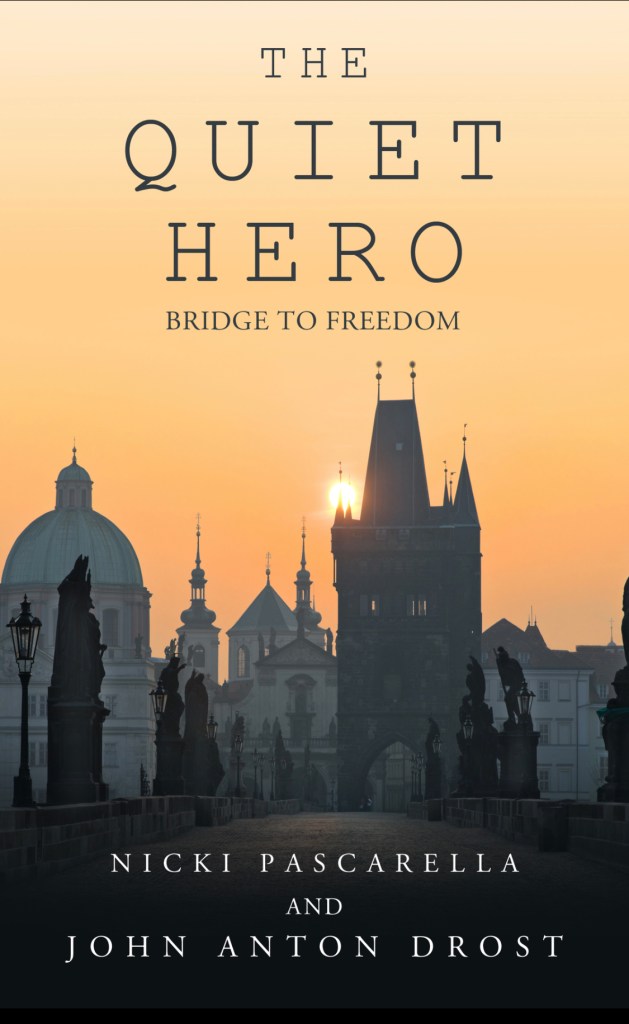
This week we are joined by Nicki Pascarella, author of contemporary and historical romances. The Quiet Hero, which she co-authored with John Drost, has been our book pick for the month of March. The Quiet Hero is the inspiring story of a Czech lawyer caught in the political struggles of 20th century Czechoslovakia. We’ve been focusing on the Czech Republic this month in our book club Travel Europe Through Books, and we are grateful to Nicki for contributing to our blog.
Painting by Joža Uprka
Why A Romance Writer Tackled Historical Fiction
by Nicki Pascarella
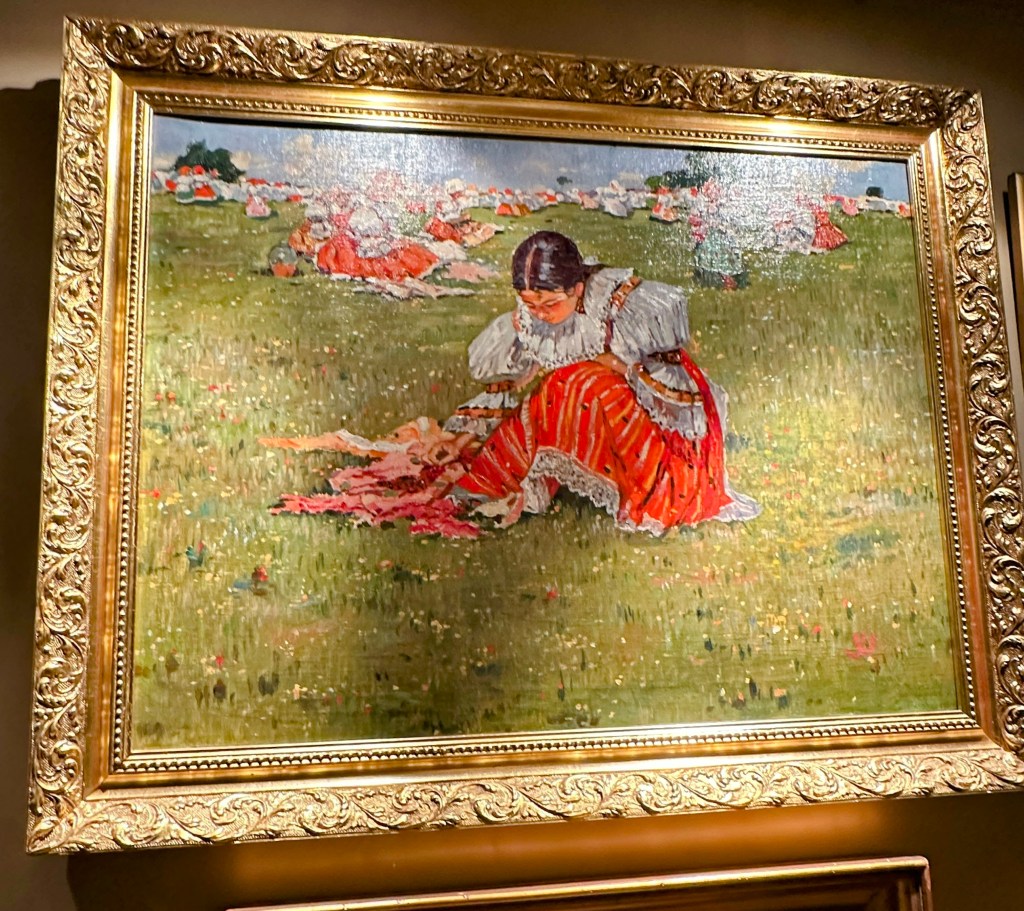
“Young Girl Bowing” by Czech painter Joža Uprka. Oil on canvas, dated 1918. 23×31 inches. This painting is from the Veseli nad Moravou Region. The girl is attending the Saint Anthony’s Pilgrimage.
One of my favorite childhood memories is sitting around the kitchen table with my siblings and cousins, listening to my maternal grandparents weave colorful tales. They were both master storytellers, able to captivate their seven grandchildren despite some of us having short attention spans. Sometimes, the tales come around to my grandfather’s war stories. He was a radio operator on a B-17 who was shot down over Germany and spent the end of the war with a stump for an arm as he was interrogated by the Gestapo and shuffled through POW camps.
When I was a teenager, my grandfather asked me to record his stories. I’m ashamed to admit that high school girl things sidetracked me. Then, I was off to college. Soon, I met my husband, landed a teaching job, became obsessed with my dogs, and raised my daughter. Yada. Yada. Yada… Almost twenty-five years after his death, I experienced a personal crisis that led me to pour my heart into reading through my grandfather’s medical records, his old newspaper and magazine clippings, and researching World War II. A year and a half later, I published his story within the pages of my debut Women’s Fiction novel, StumpStrong: Strength In Roots.
After reading Stumpstrong, my dear friend Julie Lokun sent me her grandfather’s unpublished memoir, asking, “Do you think there is a story here?” The 500-ish page manuscript had sat on a shelf in her father’s study for over thirty years.
Truthfully, I had no desire to read the dusty binder. How would I know if there was a story? I was a romance author, and my interest in war stories did not extend beyond my grandfather’s. But since Julie is my friend, I opened the book and plodded through the introduction.
Soon, I found myself drawn into this story of a young man, from another country who lived two generations before me. Vivid images of picking mushrooms in the Moravian mountains swirled in my dreams. I marched around a classroom with two dozen children chanting, “Heil, Caesar.” Wasps stung me as I was bamboozled into playing beside their swarming nest.
“What?” I indignantly called out when Jan Drost faked birth certificates to protect himself from Nazi persecution. “No!” I cried when he divorced the love of his life to protect his family. I could go on and on with these powerful moments that called to me. Then came my epiphany. If I was feeling this connection to a man I’d never met, so would others. Because—
The entire world—every single person—in every single country—is connected through our past.
And in particular, the Baby Boomers and Generations X, Y, and Z because we still have our ancestor’s traumas from the world wars running through our veins.
It was settled: this romance writer wanted to share Jan Drost’s powerful story—a story of us all—with the world.

Oil on board “Man in a fur coat from the Velka nad Velickou Region” by Joža Uprka. 1918. Oil on board. 43×23-1/2 inches.
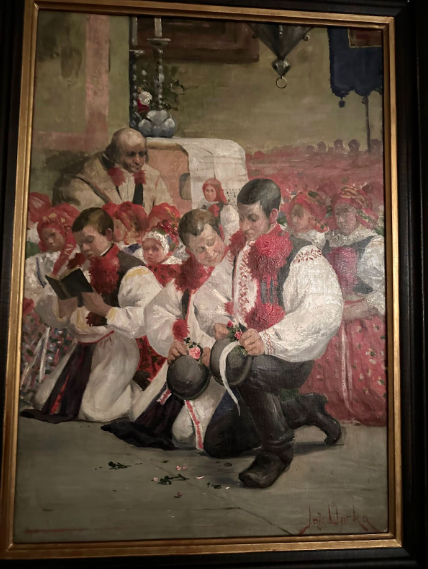
“At Church” c1890, by Joža Uprka. This was painted before Joza studied in France. The painting does not incorporate the more brilliant colors associated with his post-Paris experience.
Writing the book
I am not an expert on European History or the world wars. However, I felt a kinship with Jan. Perhaps I saw my grandfather in him. Although very different men, one American and one Czechoslovakian, they were both larger-than-life, resilient heroes who possessed indomitable spirits. I spent the next seven months sitting behind my computer, Jan’s spirit by my side. I know I sound insane, but Jan chatted with me as I tapped away. “No,” he’d say. “You didn’t get that quite right.” And then there were the moments he’d say, “Yes. That’s it. Perfect!”
I’m often asked how I decided what snippets to retell from ninety years of a man’s life. It’s simple. Once I channeled Jan, his life played like a movie in my mind. I added symbolism, an inciting incident, rising action, a climax, and a resolution. I recreated the scenes that stuck with me and tried to write them for modern readers. I did not focus on the historical events. Instead, I tried to bring to life how one man reacted to these events.
Once the manuscript was complete, I worked with Jan’s youngest son, George Drost, to ensure that my history and cultural references were correct. I can’t articulate what an honor it was to learn about—and be welcomed and embraced by another culture. I laugh when I tell people, “In my first draft, I completely messed up trying to go back and forth between the German and Czech languages. I wrote everything using a German Google translator.” Luckily, I had a patient team helping me with these errors.
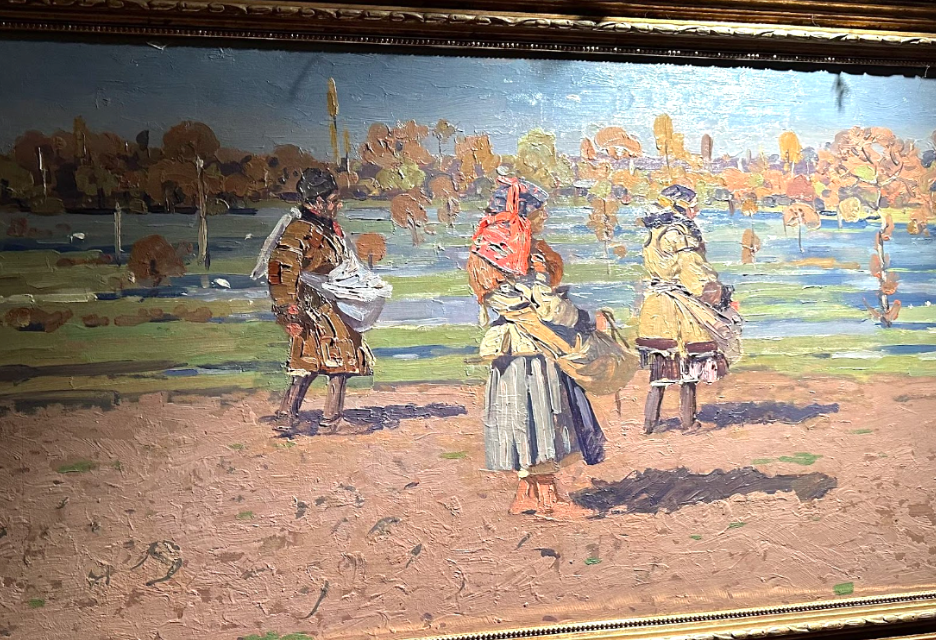
“The Sowers” by Joža Uprka. From the Uherske Ostroh Region. 1915, oil on canvas. 18-1/2×48 inches.
What do I want readers to take away from The Quiet Hero?
The most powerful lesson in Jan’s story is that the entire world is connected through this traumatic historical period. All of our ancestors lived through this, and through them, it is a part of each and every one of us.
Here is a line from Stumpstrong that captures the importance of our forefathers’ (and mothers’) stories: “I am too busy connecting to my familial roots. They grow deep, lovingly twine around everything, reach into the fresh air to breathe, and then stretch toward the sun. Why did it take the tragedy of a near-death experience for me to understand this?”
A Special Thank You
Thank you to George Drost for sharing some of his beautiful paintings by Czech painter Joža Upkra. Uprka lived from 1861 to 1940. He combined elements of Impressionism and Art Nouveau to document life in Moravia. To see more of George’s collection, check out
https://www.spurlock.illinois.edu/exhibits/profiles/national-treasure.html
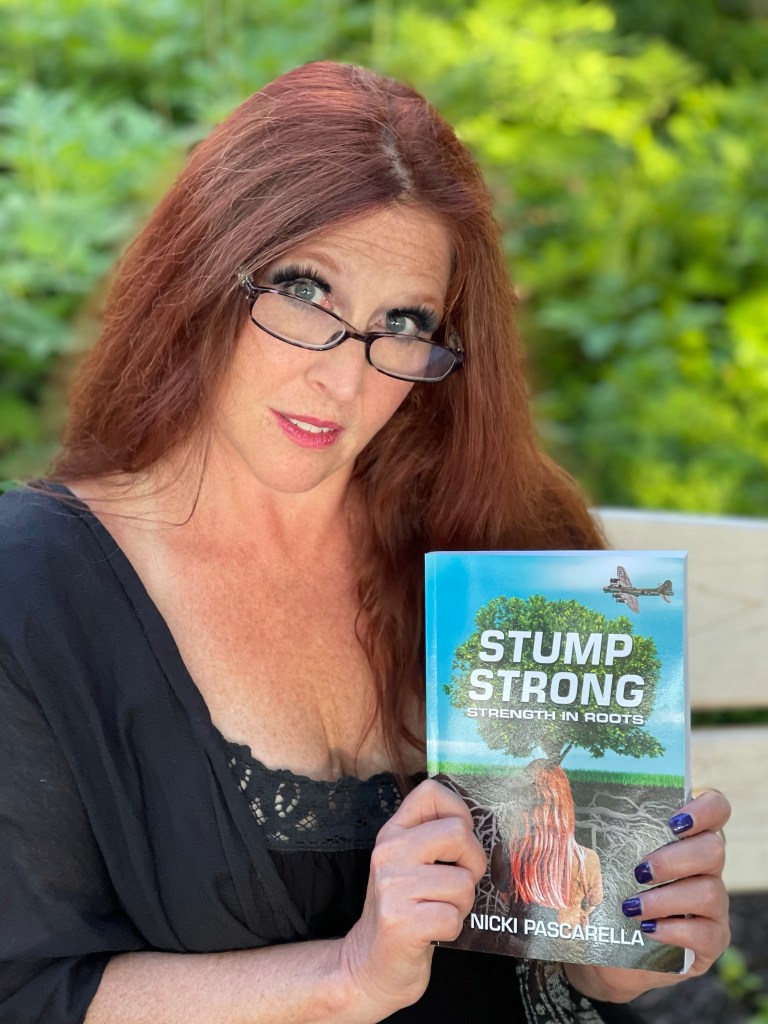
Author Nicki Pascarella
Nicki Pascarella writes Contemporary and Historical romances. She enjoys mixing genres—adding mysteries to steamy small-town romances, or a pinch of paranormal fantasy to her romantic comedies. It’s all about making her readers laugh and fall in love.
Using her twenty-nine years of experience as a high school teacher and her background in creative writing and journalism, she is passionate about helping artists break through creative blocks.
When she isn’t writing, Nicki reads, runs, and hangs with her husband, daughter, and Shetland Sheepdogs. She is also an international award-winning belly dancer.
Nickipascarella | Twitter, Instagram, Facebook, TikTok | Linktree
The Quiet Hero by Nicki Pascarella and John Anton Drost
Set against the backdrop of the unspeakable atrocities of World War 2, John Anton Drost’s true story unfolds and he emerges as a beacon of hope, defying adversity and persecution with unwavering courage. From his humble beginnings, this unsung hero embarks on a transformative journey that shapes and saves countless lives.
The Quiet Hero seamlessly combines riveting storytelling and meticulous attention to detail, ensuring it captivates both historical enthusiasts and curious readers alike. Immerse yourself in this unforgettable tale of courage, compassion, and the enduring power of the human spirit, and discover the indelible legacy of a quiet hero who defied the darkness of his time.

If you liked The Quiet Hero, you might also enjoy From the Rooftops by V M Karren:
Less than ten years after her courageous march for freedom in Bucharest, a young banker finds herself caught up in the corruption that has flourished in Romania’s transition from communism to a free market. After the mysterious death of her fiancé, her suspicions lead her to take daring steps to expose the new tyrants of the criminal networks behind the scenes and take a stand for her family and country.
V M Karren uses his masterful insight into Eastern Europe’s reformation and the international criminal networks that besieged it, to weave a story of loyalty, courage and freedom you will not soon forget.
 Travel Europe Through Books
Leave a comment